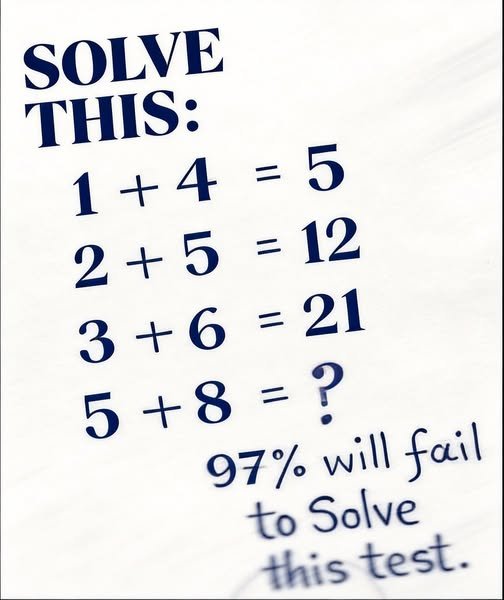
This puzzle is one of those tricky, fun challenges that can have multiple interpretations depending on how you look at it. Let’s break down some possible approaches and solutions:
Puzzle:
1 + 4 = 5
2 + 5 = 12
3 + 6 = 21
5 + 8 = ?
Approach 1: The “A + A(B)” method
One of the common patterns suggested is the rule A + A(B), where A is the first number, and B is the second number. Here’s how that would play out for each equation:
- 1 + 4 = 1 + (1 × 4) = 1 + 4 = 5
- 2 + 5 = 2 + (2 × 5) = 2 + 10 = 12
- 3 + 6 = 3 + (3 × 6) = 3 + 18 = 21
- 5 + 8 = 5 + (5 × 8) = 5 + 40 = 45
So, according to this method, the answer would be 45.
Approach 2: Adding the previous result
Another method is to add the previous result to the next equation.
- 1 + 4 = 5 (this is the starting point)
- 2 + 5 = 12 (we add 5 to get 12)
- 3 + 6 = 21 (we add 12 to get 21)
- 5 + 8 = 34 (we add 21 to the next equation’s result)
So, in this case, the answer would be 34.
Approach 3: Interpret it as a simple increasing pattern
Some people just look at the numbers and try to follow a pattern from one equation to the next. One possible way to interpret it is:
- 1 + 4 = 5 (simply, 1 + 4)
- 2 + 5 = 12 (here, it might imply a + b + a * b)
- 3 + 6 = 21 (same as above)
Then for 5 + 8:
- 5 + 8 = 32 (following a similar progression of increasing complexity)
So the answer here might be 32.
Approach 4: Number bases or binary
Some interpretations explore using number systems other than the standard decimal. This method, however, is more complex and can lead to wild possibilities like 111 or even 1101 when dealing with different number systems (such as binary or other base systems).
Final Answer:
There isn’t just one definitive answer because the puzzle is all about perspective and pattern recognition. However, based on the common interpretation, 45 seems to be a popular choice, as it fits the equation pattern A + A(B).
What answer did you get after testing the patterns?