
The Puzzle in the Image
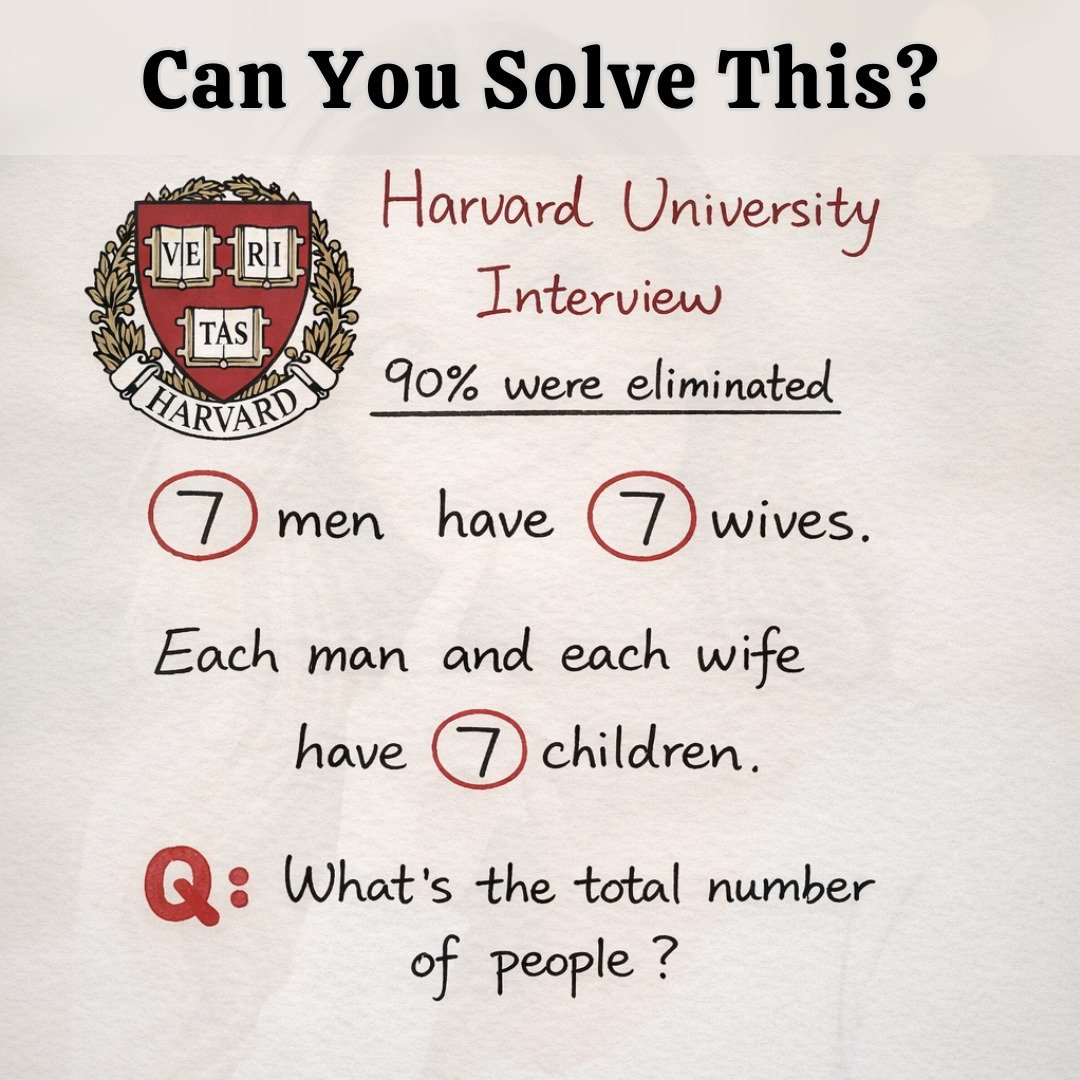
A handwritten “Harvard University Interview” riddle asks:
- “7 men have 7 wives.”
- “Each man and each wife have 7 children.”
- Question: What’s the total number of people?
The “90% were eliminated” line is there for drama, but it doesn’t affect the math.

The Key to Solving It: One Ambiguous Sentence
Everything depends on how you interpret this line: “7 men have 7 wives.”
It can mean either:
- Interpretation A (shared total): The group of 7 men has 7 wives total (most naturally read as 7 couples).
- Interpretation B (per man): Each of the 7 men has 7 wives (which would be 49 wives total).
Solution A (Most Common Reading): 7 Couples
If 7 men have 7 wives total, you have 7 married pairs.
- Adults: 7 men + 7 wives = 14 adults
- Children: If each man and each wife have 7 children together as a couple, then:
- 7 couples × 7 children each = 49 children
- Total people: 14 adults + 49 children = 63 people
Result: 63
Solution B (If Each Man Has 7 Wives): A Much Larger Family Tree
If each man has 7 wives, then:
- Wives: 7 men × 7 wives each = 49 wives
- Children: Each man–wife pairing has 7 children, so:
- 49 pairings × 7 children = 343 children
- Total people: 7 men + 49 wives + 343 children = 399 people
Result: 399
Which Answer Is “Right”?
In logic riddles, the “correct” answer is usually the one supported by the exact wording.
- The image does not say: “Each man has 7 wives.”
- It says: “7 men have 7 wives.”
That wording most strongly implies 7 wives total, leading to 63.
Takeaway: The Real Test Isn’t Math, It’s Reading Precision
This puzzle is designed to trigger a fast assumption (“polygamy”) and reward careful reading.
- If you read it as a group total, the answer is 63.
- If you rewrite it as each man has 7 wives, the answer becomes 399.