
A simple brain teaser, huge internet debate
A short math scenario has gone viral online, drawing millions of views and sparking arguments in comment sections. The challenge feels easy at first, but people often disagree because they track the money differently.
The scenario
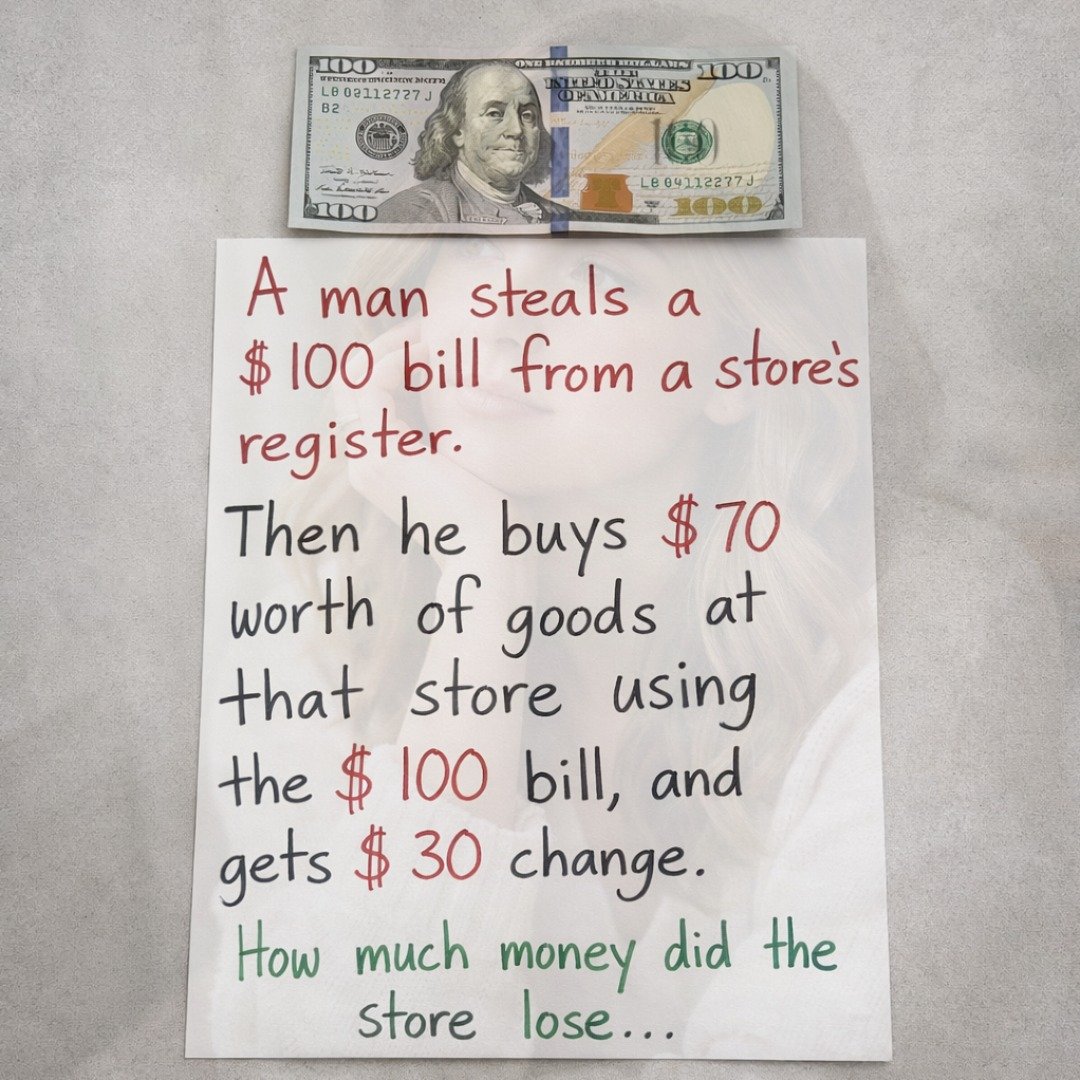
The puzzle describes this situation:
- A man steals a $100 bill from a store’s register.
- He then uses that same $100 bill to buy $70 worth of goods at the store.
- The store gives him $30 in change.
- Question: How much money did the store lose?
Common answers people argue about
Online discussions typically split into a few camps:
- $100 loss (one side says the final loss equals $70 in goods + $30 cash)
- $130 loss (others add $100 stolen + $30 change, but this double-counts)
- “It depends on profit margin” (a misunderstanding of what the puzzle is asking)
The correct way to think about it
To solve it, separate the loss into cash and goods:
- Cash impact
- The thief initially takes $100 cash from the register.
- Later, when he pays with that same bill, the store effectively gets the $100 back into the register.
- But the store then hands out $30 in change.
- Net cash loss: $30
- Merchandise impact
- The thief walks away with $70 worth of goods.
- Merchandise loss: $70
- Total store loss = $30 (cash) + $70 (goods) = $100
Why this puzzle keeps going viral
This riddle spreads fast because it exposes how people can:
- Focus on the theft and accidentally count the same $100 twice
- Confuse revenue vs. profit, even though the puzzle asks for total loss
- Jump to an answer without tracking the transaction step by step
Key takeaway
When a puzzle seems obvious but causes arguments, the best approach is to:
- Track what changes hands
- Separate cash from goods
- Calculate the net result, not the most dramatic number