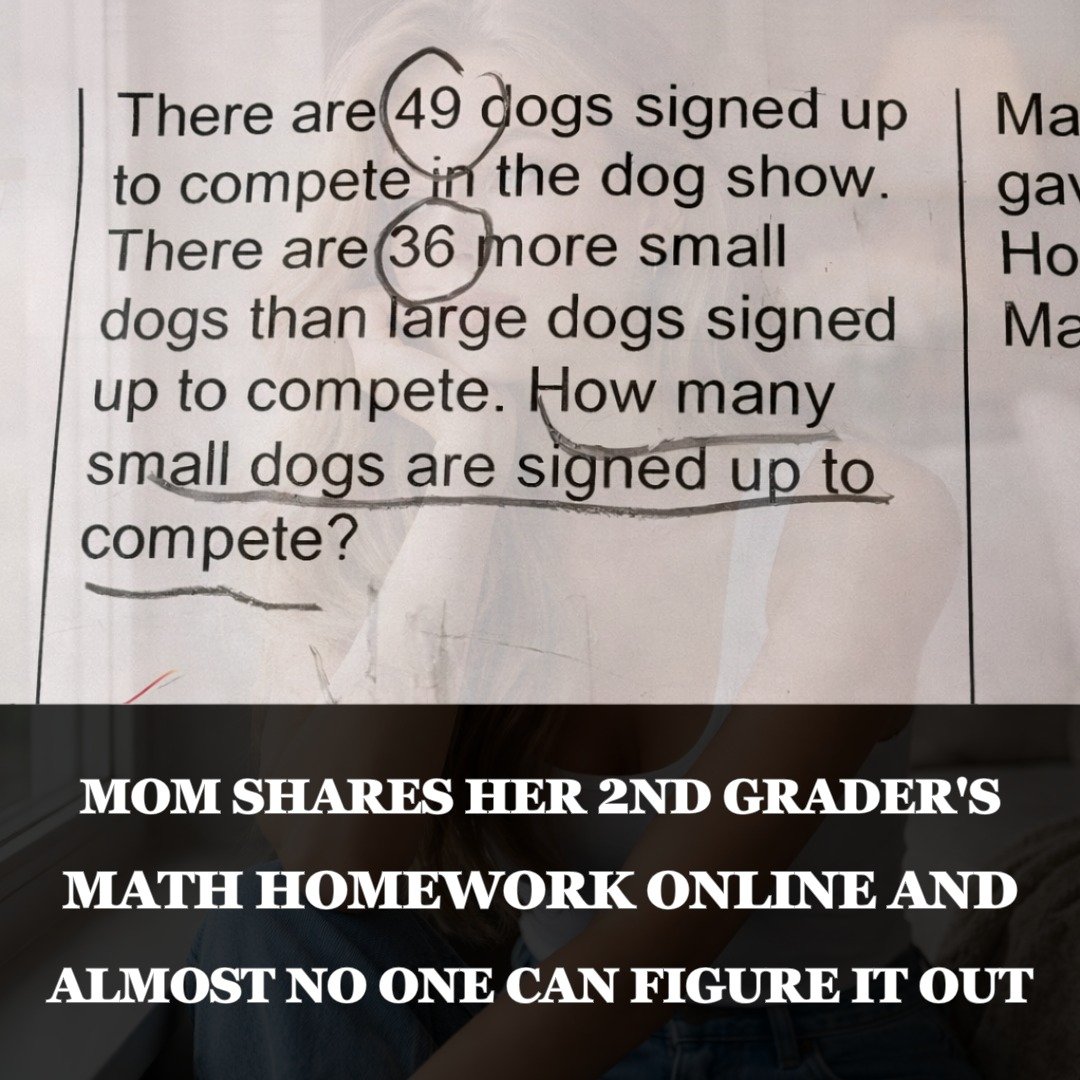

A photo of a child’s math worksheet has been widely shared online after it appeared to stump adults as much as students. The headline on the post claims that a mom shared her second grader’s homework and “almost no one can figure it out.” The reason is simple: the numbers in the word problem don’t produce a whole-number answer.
What the Worksheet Says
The problem reads:
- There are 49 dogs signed up to compete in the dog show.
- There are 36 more small dogs than large dogs signed up to compete.
- How many small dogs are signed up to compete?
The Standard Way Students (and Parents) Try to Solve It
- S = number of small dogs
- L = number of large dogs
From the problem:
- S + L = 49
- S = L + 36
Substitute equation (2) into equation (1):
- (L + 36) + L = 49
- 2L + 36 = 49
- 2L = 13
- L = 6.5
- S = 42.5
Why Everyone Gets Stuck
- A dog count should be a whole number.
- The math gives 6.5 large dogs and 42.5 small dogs, which is impossible in real life.
- That strongly suggests the worksheet has a typo (or the numbers were copied wrong).
The Quick “Sanity Check” That Explains the Issue
A useful rule:
- If S − L = 36 (an even difference), then S + L must be even too for both numbers to be whole.
- But the total given is 49 (an odd number).
- Even difference + odd total = halves (.5) result, which signals the problem is inconsistent.
What the Question Might Have Meant (Two Fixes That Work)
If the teacher intended whole numbers, changing just one number can fix it:
- Option A: Keep the difference 36, change the total to 50
- Then: L = 7, S = 43
- Checks: 43 + 7 = 50, 43 − 7 = 36
- Option B: Keep the total 49, change the difference to 35
- Then: L = 7, S = 42
- Checks: 42 + 7 = 49, 42 − 7 = 35
Why This Matters for Students
When a problem has inconsistent numbers:
- Kids may think they “can’t do math,” even though the real issue is the question.
- It’s a good opportunity to teach:
- set up equations
- check whether answers make sense
- recognize when a problem statement is flawed